Rejvak the Defiler - Designing Interesting Boss Encounters in D&D 5e
I’ve struggled with creating interesting boss encounters for D&D 5e. I will come up with an interesting concept, think of a cool introduction or moment, and then watch the encounter fall completely flat on its face. The players and monster would end up just rolling to hit each other, with occasional saving throws only resulting in more damage. There was no tension, no stakes. Even interesting mechanics such as restraining players didn’t result in the terror that comes with being powerless to flee an opponent; they were just a way to convey a slight combat advantage. Feeling burned out of my undead-themed campaign and my players not having had a significant combat in around a month, I decided to take another shot at designing an interesting encounter.
The Inspiration
Months ago, I had thought of an encounter based around the corrupted angel from Curse of Strahd. I wanted to create an encounter where a corrupted angel pursued through claustrophobic underground church catacombs, mirroring my experiences when I had toured such catacombs in Rome. However, such an angel had little to no connection to the current storyline, in which a prominent undead general was mounting an impending attack on the city. In order to preserve the church setting, I decided to cast my players’ next foe as a prominent lieutenant, one who had taken over a church and used it to camp an invading army of zombies. This idea of having reversed the usage of a holy site stuck in my mind, and Revjak the Defiler was born.
The Ideas
I found a fantastic stat block from Reddit User Mischief to use as a base: the Wythersake. I find that with 5e it is often best to start with a similar stat block to build off of that includes condition immunities, languages, senses, and other details that may become relevant in game but that take unnecessary time out of session prep. However, I had a very clear concept for Revjak. I envisioned him as a large minotaur skeleton who wielded a large axe. Although he centred around defiling holy artifacts, the underlying theme was still religion, so I decided to describe him as having strings of large bells draping from his horns, like wind chimes.
The bells would be an important signal of his location, as the party would eventually face Revjak in completely dark catacombs. To further iterate on this, I decided to give Revjak a sort of lair action where he could ring the bells of the church to potentially deafen his opponents, leaving them without clues to his location.
A big part of Revjak was his ability to supposedly defile holy artifacts. To give him a motivation for this, I wanted holy artifacts to impair him somehow.
Revjak should have some ability to defile the players, and to differentiate his attacks I wanted him to deal harm to the players in some way other than through their hit points.
Finally, I wanted to connect an overarching infection plotline that had been inflicting the city to Revjak, so I wanted to have him be able to inflict some sort of poison or disease status effect on the characters.
Writing Out the Statblock
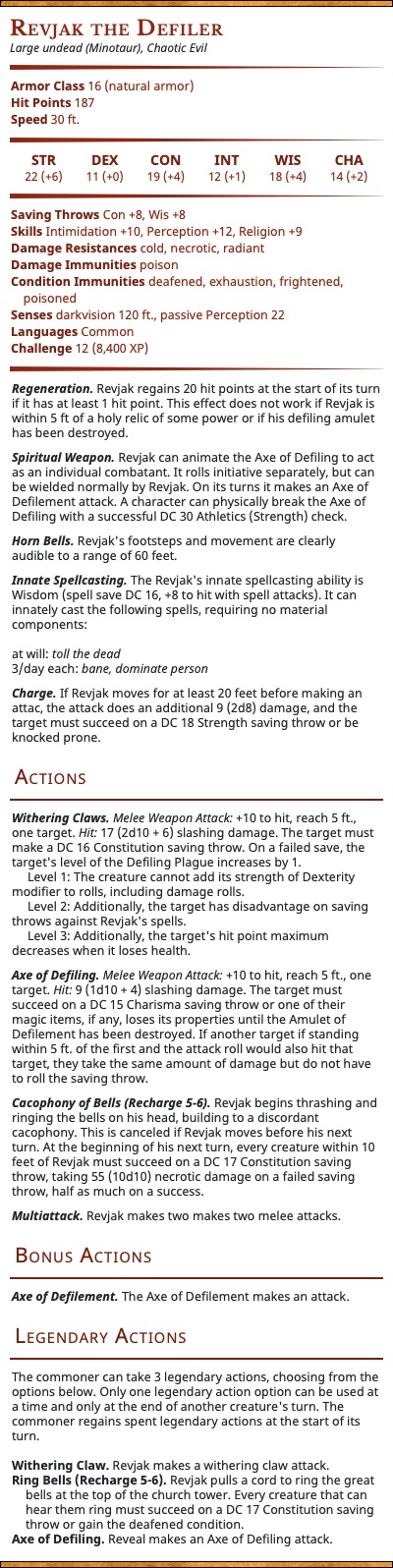
I created the stat block through the D&D 5e Statblock Generator. I’ve been using this website to develop stat blocks for years, and I find it to be better than D&D Beyond’s monster creator. I’ve included a .monster file at the end of this article that you can import Rejvak into the site and modify him for your games.
Basic Statistics
Revjak has an AC of 16 to make him fairly easy to hit (my players are currently 7th level) in order to show the players how he is a lumbering hulk instead of a nimble operator. I picked the health value fairly arbitrarily based on my group’s previous damage output.
Revjak’s stat profile is weighted toward strength and constitution because he is a brawler, but I kept his high Wisdom statistic to reflect his knowledge of the holy and his intuition for magical phenomena. Most of my knowledge of 5e creatures’ stat profiles comes from Keith Ammann’s book The Monsters Know What They’re Doing. If you intend to run a D&D game in the future and want to make your encounters interesting and deadly without having to design custom monsters, I recommend giving it a read to see how you can analyze stat blocks to determine how monsters would logically fight.
Abilities
Revjak’s regeneration stands at a cool twenty hit points per round. While a 7th level party is often dealing more than this, it is enough to make them realize that they are fighting an uphill battle. However, in order to make the fight feel mentally engaging and more like a puzzle, I gave the players two avenues to disable the regeneration. Holding holy relics close to him, as well as destroying his Defiling Amulet. Adding puzzle-like elements to enemies also gives players with lower damage output or more utility-based characters something to do, as they can spend their turns making rolls to divine facts about the creature, and devising strategies to defeat them in tandem with the more directly damage dealing heroes of the party.
While Revjak’s Spiritual weapon is essentially a copy of the spell with a few flavour changes, making it an ability increases the readability of the stat block. Making the axe its own actor on the battlefield gives Revjak more action economy and allows for interesting situations where the players fight the axe separately from Revjak, weakening them before the final fight.
Revjak’s innate spellcasting gives him a singular damaging cantrip, as well as a debuff spell reflavoured as an infection, which he can cast at the beginning of combat or before combat starts. The big gun in his limited spell arsenal is dominate person, which is the main threat when paired with the infection ability of Revjak’s claw attack.
Finally, Revjak’s charge attack thematically works with his minotaur appearance, and also gives him a motivation to move around the arena in an interesting manner.
Actions
Revjak’s main attack is his Withering Claws, an attack that I based off of the Wythersake’s identically named attack. The interesting thing about Revjak’s claws is that the infection he inflicts on characters builds in levels, meaning that characters who have already been hit have real incentive to back off of Revjak and recover so as to not contract the more deadly levels. The first level is already bad enough, and functions as a way for Revjak to punish the characters that would naturally get in his face: the melee attackers using Strength and Dexterity. If this curse does not convince them, the second level cripples their defenses, both against the third level of the disease and against Revjak’s dominate person. The final level is devastating both on a mechanical and on a narrative level. I wanted characters to feel like they were turning into rotting undead (literally being defiled). If you run this monster, make sure to throw in visceral descriptions of the third level in order to scare your players and to make sure that once one party member can no longer be healed, no others want to try and get close to Revjak.
The Axe of Defilement (used either by Revjak on his turn, during his bonus action, or on its own initiative) has a basic cleaving ability where it can hit adjacent targets, trying to disincentivize players from crowding around Revjak. Its more interesting ability, however, is its ability to disable magic items. You can resolve the disabling of magic items in different ways but, seeing as I make magic item cards for my players, I found the most fun way to be to blindly pluck a card from them. The axe can also be physically broken, once again presenting a more unique challenge to the players if they have some way to pile buffs on a specific character.
Cacophony of Bells is the big-ticket item in Revjak’s arsenal, recharging on a roll of 5 or 6 at the beginning of Revjak’s turn. Importantly, this attack is an area of effect that affects everyone in a radius around Revjak, but only triggers after everyone except Revjak has taken their turn, giving party members a chance to avoid the attack entirely. This forces party players to rethink the positioning of their characters and creates the possibility for interesting situations where Revjak can grapple a character and then change the focus of the combat to freeing this character.
Revjak, as a legendary action, can also ring the bells lying at the top of the location in order to deafen characters, which is important in situations where the party fights Revjak in darkness, as the sounds made when he walks are then the only ways of identifying him.
The Maps
Revjak is fought in two locations: the first floor of a church, which he has recently taken over and defiled, and the underground catacombs of this church. In the middle of the fight, if Revjak notices that he is taking more damage than he can regenerate, he can separate the party by collapsing the floor. Once the party falls into the catacombs, they are separated to the four corners of the map in complete darkness and must find themselves and Revjak, while he heals using his regeneration and stalks them, one by one. For the first floor of the church I used this map which I found on r/battlemaps posted by a user named EithfoldPaper. For catacombs, I used a dungeon map I found on r/dndmaps pasted by a user named DysonLogos. I placed a simple layer of black pixels over the catacombs in a photo editor, and then erased parts of it when my players explored more and more of it.
Wrap Up
Revjak is an interesting encounter to break up a larger campaign, or even a sub-villain to build a short arc around. I hope that you get as much fun out of him as my table did!