Developing a Gun Combat System
When we play TTRPGs, we are often looking to balance the cinematic smoothness and interest of the situation with meaningful tactical decisions that separate playing the game from merely playing pretend. I find that firearm combat is a good example of this. The cinematic shoot-outs found in Spaghetti Westerns, John Wick, and Tarantino’s films are often at odds with the methodical, precise gun combat of video games (to be clear, I am not speaking of competitive First-Person Shooters, both because they usually do not hold the story of the characters as important and because I have limited experience with them).
Movies do an excellent job of showcasing the emotional stakes of a gunfight and their repercussions, but pulling from movies leads to a system more based around a character’s metaphysical currency of coolness and plot relevance, leading to a system that equates gunfights with other skill tests, instead of presenting it as its own unique challenge. Video games, by contrast, rely on satisfying sound and visual design, the promise of tangible rewards, and a moral excusing of mass slaughter. These aspects are not present in TTRPGs, meaning that tactical gun combat can quickly become stale.
Therefore, I’ll set the following constraints for my design of a gun-combat system:
- Cover Mechanics (we want to keep this fairly realistic and grounded)
- Non-Cover Mechanics (the system shouldn’t assume cover to always be present)
- Aiming (a player should be able to sacrifice something in order to try to aim at a specific body part)
- Health Detriments/Benefits (taking bullet wounds should decrease the effectiveness of a character)
- Variable guns (different guns should have different upsides and downsides)
- Gun Jam Rules (guns need to have a possibility of jamming to heighten stakes)
- Reloading rules (having to reload should be a consideration)
- Relative rules lightness (the rules should fit on one page, and be easy to remember and use, without a huge amount of edge cases)
- Shooting should not be the only viable option
- The gameplay should remain exciting
Basic Mechanics
I want the base of this system to revolve around rolling a pool of 10-sided dice and then looking for a number of successes, similar to Vampire: The Masquerade. Getting at least one success indicates having hit your opponent, with more successes indicating more damage.
In order to keep the rest of the combat system as simple as possible, yet flexible, I will give every combatant three actions, which can be used to shoot, move, or perform any other action. Every point of damage taken decreases your pool of actions by 1, meaning that after becoming damaged, a character has to play more tactically and more carefully. To prevent losing at combat equating to losing agency in the game (never a fun design solution), I might eventually include powers or consumable items that you must consume in order to retain your pool of 3 actions.
Cover
Shooting from cover raises an important concern: one of chronology. If a character shoots and remains standing from behind their cover, the next shooter could then take their turn, favouring the combatant who shoots later. If characters can retreat to cover after shooting, turn-based combat means that neither side can ever take advantage of an exposed foe. Creating a system of chronology that takes into account the riskiness of different characters’ usage of cover requires making some leaps of logic.
For our cover system, cowering behind cover gives characters the ability to negate up to three dice rolled by someone trying to shoot them. However, for every action on their turn that requires leaving cover (shooting, moving, etc), they lose one of these dice. Using this system, an outnumbered character can hunker behind cover for all three of their actions, negating many of their opponent’s dice and making a hit unlikely. Conversely, they can spend all three of their turns attacking others if they know their foes are reloading or aren’t behind cover. These “cover dice” last until the beginning of the combatant’s next turn. This way, the person who shoots first in a duel cover situation has a disadvantage, but the cover dice are not consequential enough that simply waiting for your opponent becomes the optimal strategy.
However, there should still be a strategy to fully commit to using cover. To allow this, characters can drop to be Prone using one of their actions. While prone, a character gains two more cover dice if they are behind cover, cannot shoot while behind cover, and must use all of their actions to take one movement action.
Variable Weapons
Currently, the system is unexciting, and situations only change with the terrain. Time to add different weapons. Since I might eventually incorporate this system into a western-inspired game, I will include three weapons: a revolver, a bolt-action rifle, and a double-barrel shotgun. The following considerations differentiate weapons:
- Magazine Capacity
- Difficulty to roll successes (how difficult the weapon is to use)
- Range
- Damage
Magazine capacity is easy to implement, it is simply the amount of times you can fire the weapon before having to reload. The difficulty to use a weapon can be defined by the number you have to roll on a d10 in order for it to count as a success. For example, a shotgun should have a 6 as the required value while a revolver might have a value of 8. This would mean that rolling an 8 or above with a revolver means that die counts as a success, while you only have to roll a 6 or above with a shotgun, giving a 30% and 50% chance to roll a success on any die respectively.
In order to keep the system rules-lite, I would like to establish range in a similar way to Daggerheart. Ranges are then defined as Close-Quarters, Short, Medium, Long, and Extremely Long.
- Short Range extends to around 10 meters, and no weapons gain penalties at this range (unless the weapon is only suited for long ranges, such as a sniper rifle or heavy machine gun)
- Medium range extends to around 30 meters, where most gunfights take place
- Long range extends to around 100 meters. All weapons lose one success at this range.
- Extremely long range is only accessible to certain weapons
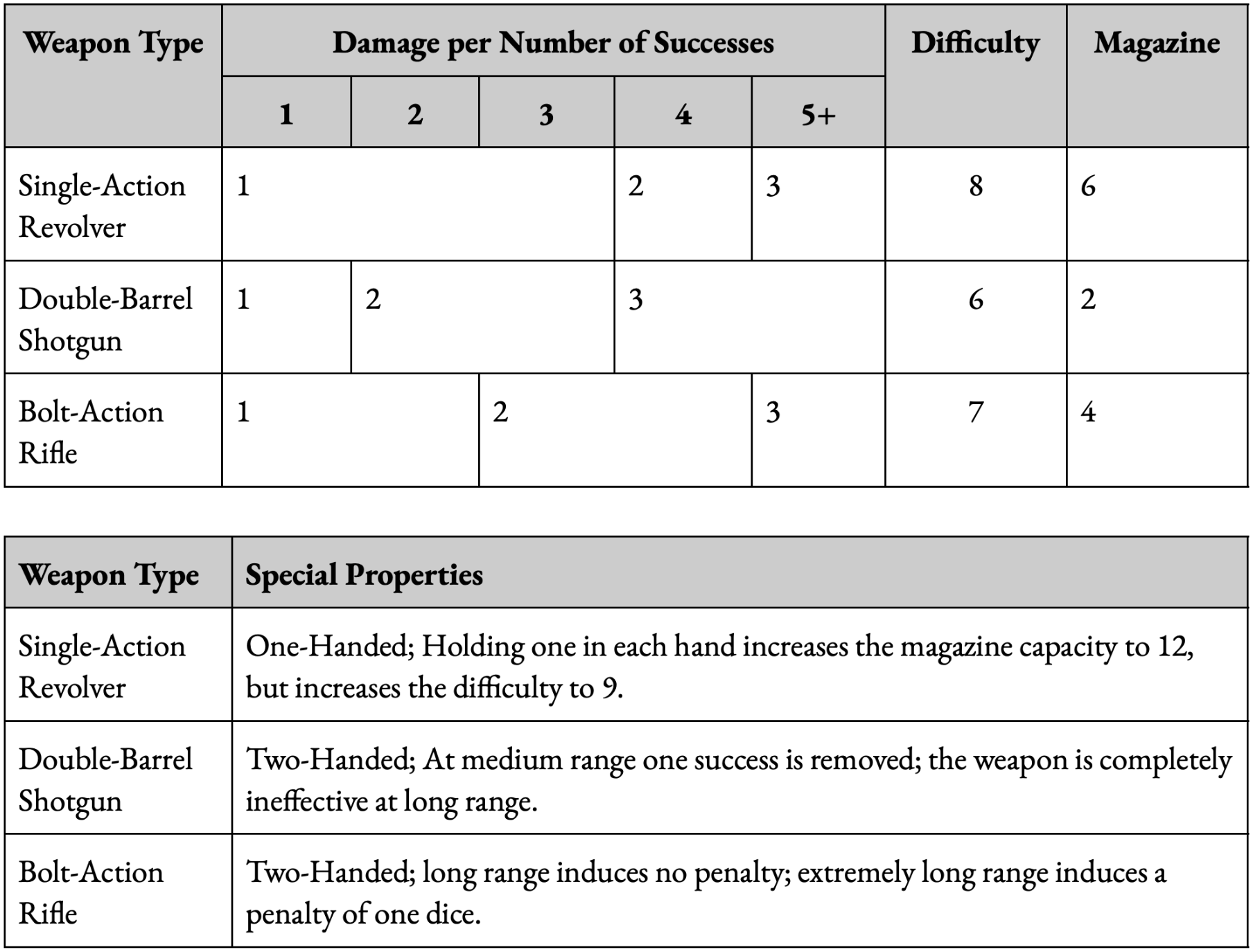
Finally, damage. When a player rolls a number of successes on their dice pool, the amount of damage they do is then based on their specific weapon’s “damage map,” which should be accessible on their character sheet. A full breakdown of the properties of each weapon is included below.
Called Shots
Since we want players to have as much freedom as possible in how they approach a situation, they should have the opportunity to simply incapacitate their opponents instead of killing them. We can refer to this as a called shot. When a player chooses to make a called shot, they lose 2 dice from their attack, and will only deal 1 damage to their opponent, no matter the roll. However, in exchange, if they manage to hit their target, that target will become incapacitated.
- While incapacitated, a combatant must use all their actions on movement in order to move, and will only gain the benefits of one movement action.
Aiming
In most TTRPGs, using your turn to aim or benefit a futue attack is a waste of resources. Consider True Strike, Widely considered the worst D&D spell, as it uses a combatant’s turn to allow two chances at a future attack. Instead a character should simply attack on both of their turns, gaining the same likelyhood to hit with the added benefit of potentiall hitting twice. However, sometimes a character’s first attack matters much more. In the case of our system, if a character spends one of their actions aiming, they gain one additional dice for their next weapon attack. This does, however, force them to peek out from behind cover.
Putting it All Together
Currently, the system is merely a loose collection of ideas and mechanics, instead of a functioning and playable system. While I might eventually incorporate some of these gunplay mechanics into a larger system, what is currently needed is a backbone to keep the game running in order to play with these ideas.
Characters will have two key statistics: Athletics and Gunplay. Both of these statistics range from 1-4, and you can roll for each one or you can divide 5 points between them. Gunplay and Athletics both have three skills associated with them. Gunplay has Revolver, Shotgun, and Rifle while Athletics has Running, Grappling, and Endurance. Once you have distributed points between the two larger attributes, you divide the number of points allocated to the larger attribute among the skills.
For example, if I roll up a character that has 2 in gunplay and 3 in athletics, I then invest 2 points between Revolver, Shotgun, and Rifle and 3 points between Running, Grappling, and Endurance.
Running
Your running stat determines how far your character moves when they use one of their actions to move; the distance they travel is calculated by multiplying the number of actions spent on movement by the character’s running stat plus 1.
Grappling
Grappling is in order to give players another option besides shooting each other, and to somewhat counter the shotgun’s power on short ranges. When you attempt to grapple a combatant, both of you roll dice equal to your grapple stat. A success is achieved on a roll of 6 or more. If the initiating combatant rolls more successes than the defender, the defender is disarmed and the two begin grappling. If the defender wins, they do not lose their weapon. If either combatant is able to roll 3 more successes than the other, they deal 1 damage to their opponent. While grappling, characters roll their grappling skills to deal hits worth 1 damage to each other.
Endurance
Endurance is a skill that determines your health value. For every two points you put into Endurance (rounding down), you gain another health point beyond the three you start with. If your health ever falls below 3, you lose that many actions.
Gunplay
When you shoot, you add your gunplay statistic and the skills corresponding to your weapon to form your total dice pool.
Takeaways and Downloadables
Ultimately, this gun combat system was a design exercise. It was a process where I saw something that I liked in video games and movies and tried to build a fairly dynamic system to recreate it in a TTRPG. Games are always better when the rules of the game serve a specific fantasy. I am considering running a Western-inspired TTRPG game at some point, and these gun combat rules are where I will start to build out a system if I end up running that game.